

Laser surgery for pilonidal sinus without a large incision
During the procedure, under local anaesthesia, we first clean the tract of hairs and dead tissue. Then we insert a thin laser fibre which, as it is gradually withdrawn, treats the wall of the tract and helps it close. The procedure usually takes up to an hour. Only small openings remain on the skin, which heal over several weeks. Most patients return to normal activities after a few days.

Examination before the procedure
The proctologist examines the area above the tailbone, counts the openings and assesses where the tract leads. Based on that, he will tell you whether the SiLaC method is suitable for you.

Cleaning the tract
We remove hairs and dead tissue from the tract. Without this the sinus could not heal.

Laser closure
The laser fibre treats the wall of the tract from the inside. The tissue shrinks and the tract then gradually closes as it heals.

Local anaesthesia
We perform the procedure as an outpatient procedure under local anaesthesia. Neither general anaesthesia nor hospitalisation is needed.

Small wounds without stitches
Instead of a long incision, only small openings remain on the skin. They heal on their own and only need to be covered with a dressing.

Follow-up after the procedure
At the check-up we monitor healing and explain how to care for the area so that the sinus does not come back.
How much does pilonidal sinus treatment cost?
The SiLaC laser procedure costs €1,400. Before the procedure a deposit of €200 is paid, which is deducted from the price of the procedure. The doctor will assess at the consultation whether the method is suitable for you.
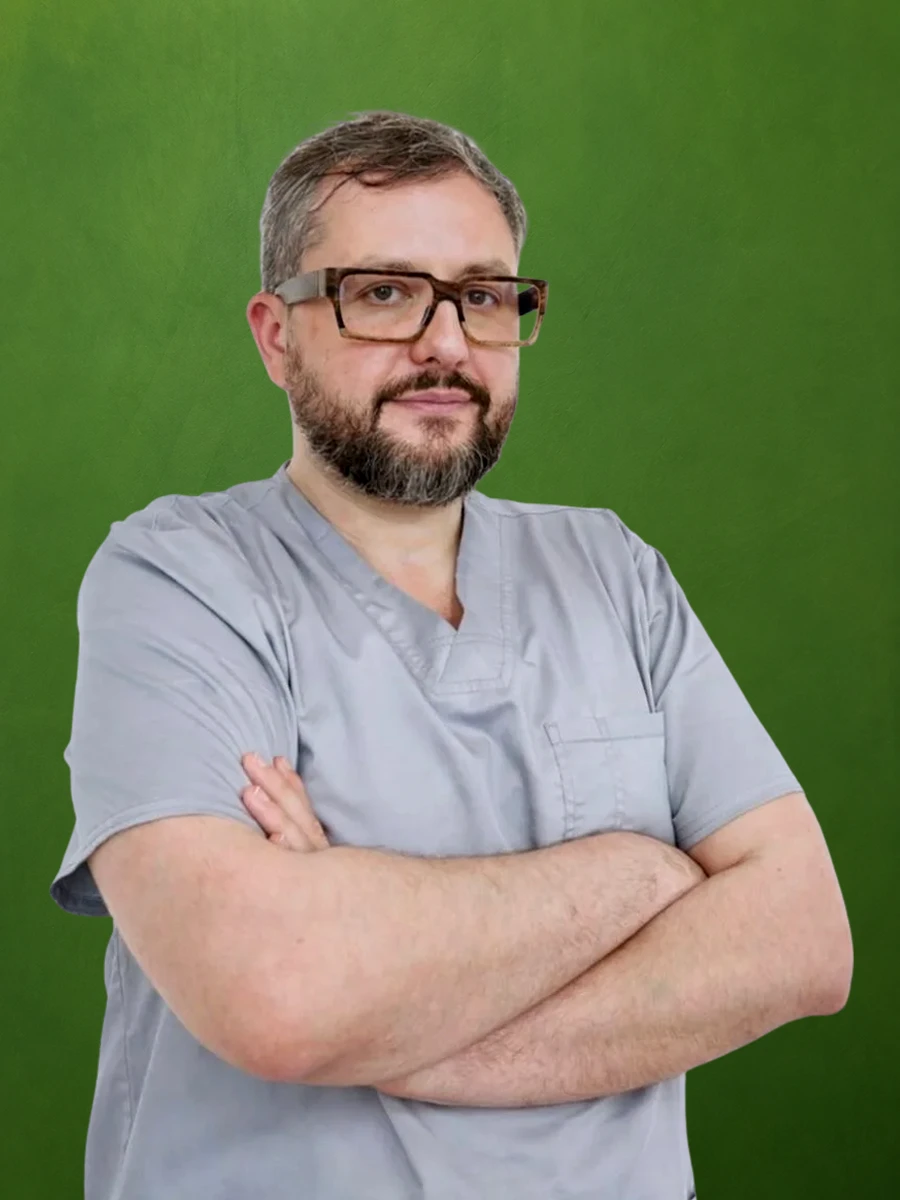
Gergely Kremeshnyy
Pilonidal sinus treatment is performed by Gergely Kremeshnyy, a proctologist and surgeon specialising in diseases of the rectum and perianal area. He studied general medicine at Uzhhorod National University from 2005 to 2011.
From 2015 to 2019 he completed training in laparoscopic and minimally invasive colorectal surgery, and from 2017 to 2018 also in hernia surgery. In 2019 he gained experience abroad during a colorectal internship at Hospital de Sant Pau in Barcelona.
At Dermarevolta he treats haemorrhoids, anal fissures, perianal fistulas, abscesses and pilonidal sinus, including laser procedures. Before the procedure he will explain what you can expect from laser treatment, how to care for the wounds and what helps reduce the risk of recurrence. You can consult him in Slovak, Hungarian, Ukrainian, Russian and English.
When to book an examination
Why have pilonidal sinus treatment at our clinic
Proctologist and surgeon
Both the examination and the procedure are performed by Gergely Kremeshnyy, who specialises in proctology and laser procedures.
No large incision
The SiLaC method does not require cutting out the whole area and leaving an open wound, which takes long weeks to heal after conventional surgery.
Home the same day
We perform the procedure as an outpatient procedure under local anaesthesia. After a short rest you go home.
Price known in advance
You know the price of the procedure in advance. We are a private clinic and you do not need a referral.
Check-up and aftercare
After the procedure we will book you for a check-up and explain how to care for the wounds and how to reduce the risk of recurrence.
Discreet environment
You have enough time for the examination and can ask about anything in peace.
Frequently asked questions about pilonidal sinus
It is a tract in the skin in the cleft between the buttocks above the tailbone. It forms when hairs push into the skin and the body creates a cavity around them that becomes inflamed repeatedly. It most often appears in young men, with thicker body hair and long periods of sitting. One or more small openings are usually visible on the skin.
Usually not. The inflammation may subside for a while, but the tract with hairs remains in the skin and the problems come back. Treatment is easier while the sinus is smaller and not acutely inflamed.
Under local anaesthesia, the doctor cleans the tract of hairs and dead tissue and inserts a laser fibre into it. The laser treats the wall of the tract, which then gradually closes as it heals. The procedure usually takes up to an hour and you go home the same day.
The procedure is performed under local anaesthesia, so apart from the injection you should not feel pain. After the anaesthesia wears off, the area is tender for a few days. Ordinary painkillers are usually enough.
The small openings after the procedure usually heal over several weeks and only need to be covered with a dressing. Most patients return to work or school after a few days. Limit long sitting, cycling and sport until the doctor confirms at a check-up that the wound is healing well.
Yes, a pilonidal sinus can come back after both laser and conventional surgery. Thorough hygiene and regular hair removal above the tailbone reduce the risk. If the sinus comes back, the laser treatment can usually be repeated.
If severe pain, rapidly growing swelling, redness or fever appears above the tailbone, it may be an abscess. See a doctor as soon as possible. Laser treatment is only performed after the acute inflammation has settled.
At our clinic we also treat
Haemorrhoid treatment
Laser haemorrhoid treatment (LHP) without incisions or stitches, on an outpatient basis under local anaesthesia.
Anal fissure treatment
Targeted treatment based on the duration, extent and cause of the fissure.
Condyloma removal
Removal of condylomas in the anal and perianal area.
Laser fistula treatment
Minimally invasive fistula treatment that preserves sphincter function.
Book an examination or consultation
Fill in the short form or contact us by phone. Together we'll find a time that suits you.
Contact
Dermarevolta